
For most people, booking a tree felling job means watching a crew arrive, and a few hours later the tree is gone. But there's a lot more going on than "cut it down." Here's a step-by-step look at what actually happens on a professional tree felling job — and why each stage matters for your property and everyone's safety.
If you've read our article on what tree felling costs, you'll know that every job is priced on its own merits. This article is the companion piece — it explains what you're actually paying for when a professional crew takes on the work.
Stage 1: The assessment
Before a single cut is made, the job is assessed. This happens at the quoting stage and again on the day, before work starts. The crew is looking at:
- Which way the tree naturally wants to fall — its lean, its weight distribution, where the heavy branches are
- What's underneath and around it — buildings, walls, pools, fences, flower beds, the neighbour's property, power lines
- How the tree will be dismantled — can it be felled in one piece, or does it need to come down section by section?
- Access — where the truck and chipper can go, how far debris has to be carried
This is the stage that separates a professional job from a risky one. A tree dropped without proper assessment is how roofs get damaged and people get hurt. The plan is made before anyone picks up a chainsaw.
Stage 2: Setting up and safety
Once the plan is set, the crew sets up. This means cordoning off the work area, positioning equipment, and rigging ropes where needed. Every member of the crew wears the appropriate protective gear — helmets, eye protection, safety pants for chainsaw operators, safety boots, and all other standard PPE.
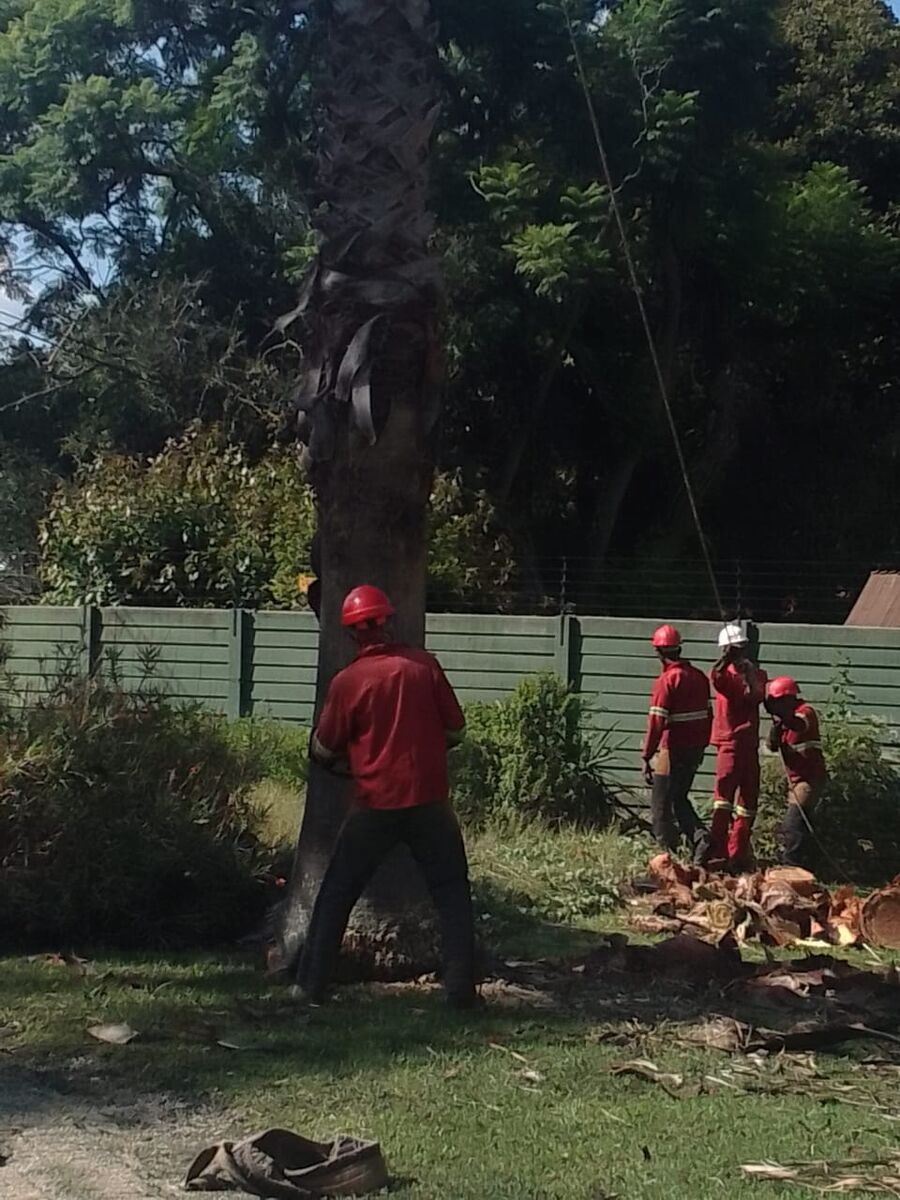
Ropes are one of the most important tools on site. For any tree that can't simply be dropped in open space — which, in a typical Gauteng garden, is most of them — ropes let the crew control the direction and speed that the tree, or each section of it, comes down. This is what keeps the job away from your roof, your wall, and your pool.
Stage 3: The climb and the cut
For tall trees in tight spaces, the tree is dismantled from the top down. A climber goes up — using a ladder, climbing spikes, or a rope-and-harness system depending on the tree — and removes the tree in manageable sections, working downward.
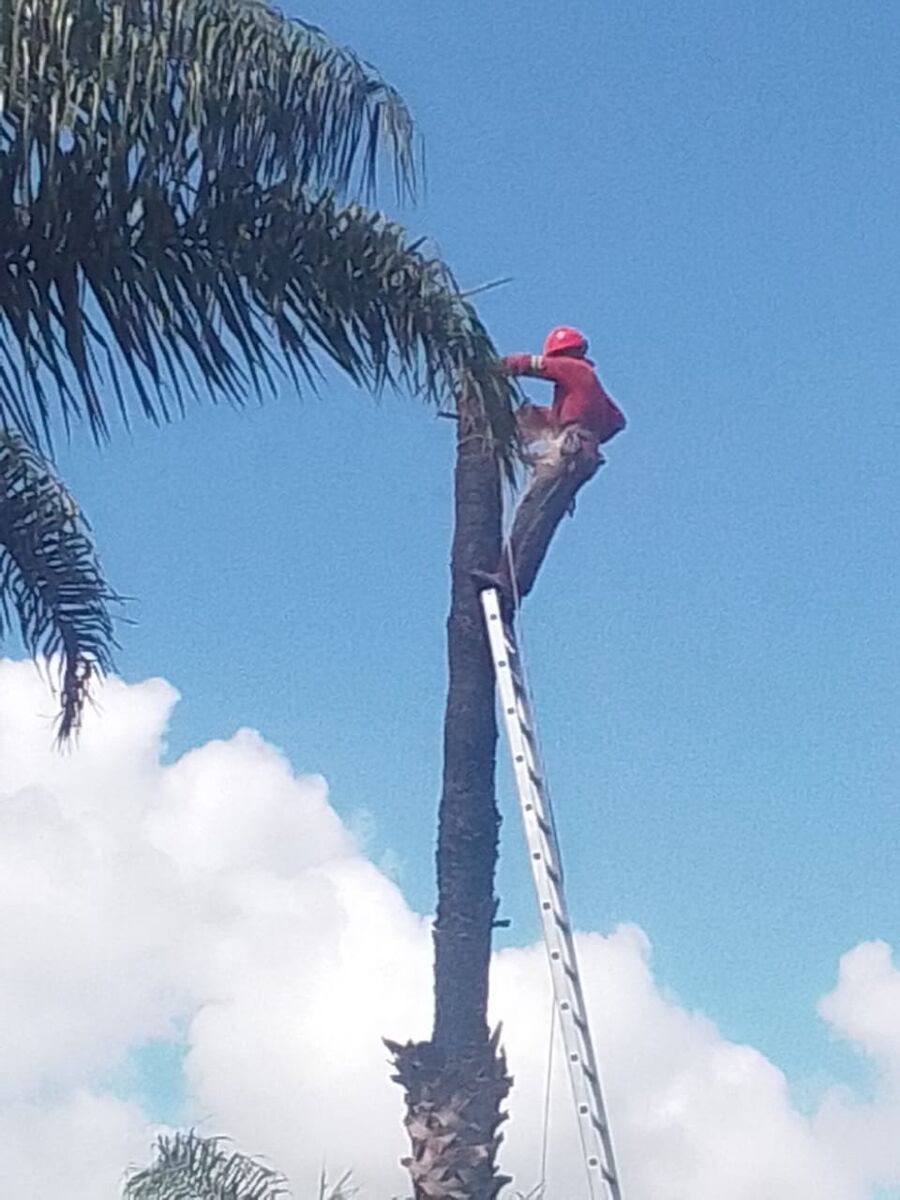
This piece-by-piece approach is slower and more labour-intensive than dropping a tree in one go, but for most suburban properties it's the only responsible way to work. Each section is cut, lowered or dropped into a clear space, and processed before the next one comes down.
Where there is space — on larger properties, smallholdings, or commercial sites — a tree can sometimes be felled whole in a single controlled drop. Even then, the direction is carefully planned and guided.
Stage 4: Processing and clean-up
As the tree comes down, the material has to be dealt with. Branches are fed through a chipper, and larger trunk sections are cut into manageable pieces. This is a bigger part of the job than most people expect — a mature tree can produce a surprising volume of waste.
A proper tree felling service includes clearing all of this away. When the crew leaves, your property should look like it did before — minus the tree. If a quote doesn't make clear whether clean-up and removal are included, that's always worth asking about before you book. (We cover this and other things to check in our article on what tree felling costs.)
Stage 5: The stump
Felling the tree leaves a stump. What happens next is up to you — and it's worth knowing that stump removal is usually a separate part of the job, because it needs different equipment.
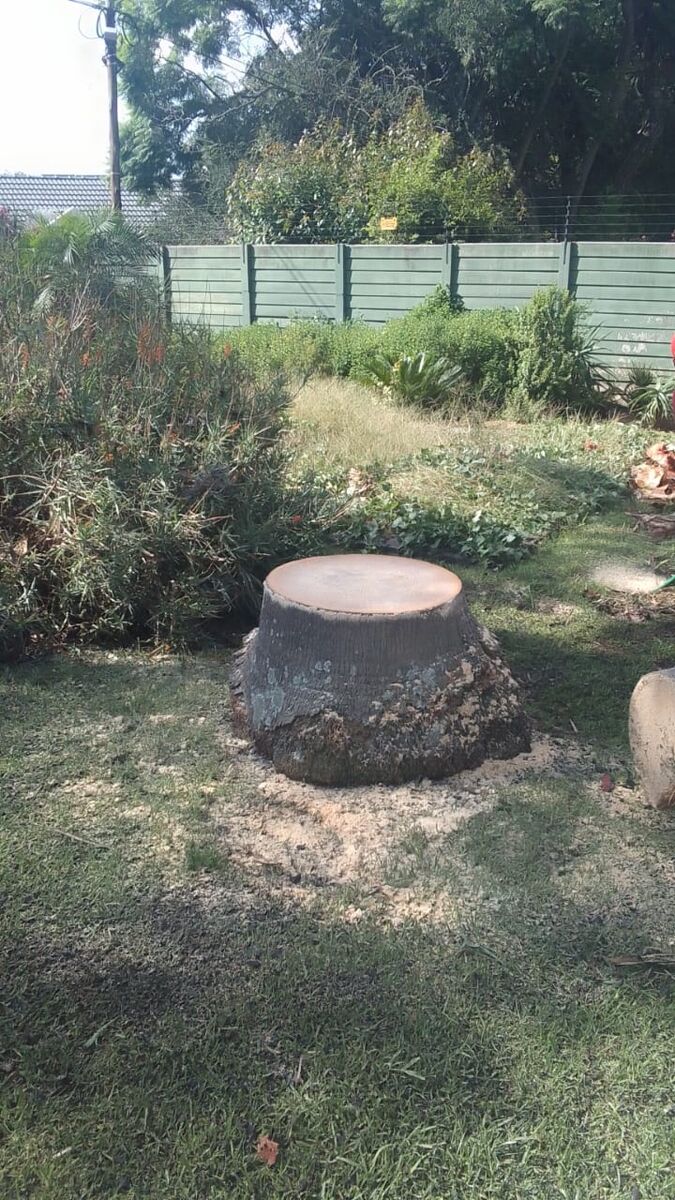
You have three basic options:
- Leave the stump — cut low and neat as a possible option. This is the simplest and cheapest, and fine if the stump isn't in your way and you don't plan to build, pave, or replant over it.
- Manual destumping — the crew physically digs out the stump along with the root ball directly beneath it (the dense mass of roots immediately under the trunk, not the wider root network). This is the option we use most often. It's essential if you plan to build a wall, foundation, or paving where the tree was — the open hole left after the stump and root ball are removed gives the crew clear ground to work with for whatever's built next.
- Stump grinding — a stump grinder removes the stump below ground level, so the area can be lawned or planted over. Quicker than manual destumping, but it leaves the root ball in place beneath the surface. Needs a separate machine and access for it.
If you know you'll want the stump gone — and especially if you're planning to build over the area — mention it when you request a quote so it can be factored in from the start.
How long does it all take?
It depends entirely on the tree. A small ornamental tree in an open garden might be a couple of hours for a small crew. A large tree in a tight space, dismantled section by section with rigging, can be a full day's work for a larger team — sometimes more. The assessment stage is where a realistic timeframe gets set.
What this means for you
The main thing to take away: professional tree felling is a planned, methodical process, not just cutting. When you're choosing who to hire, the things that matter are the things you can't always see in a quote — proper assessment, the right safety equipment, controlled rigging, and a crew that leaves your property clean.
A tree felling job done properly is calm and controlled from start to finish. If it looks chaotic, something has gone wrong with the planning.
Got a tree that needs to come down?
Send us a photo on WhatsApp or give us a call. We'll assess the job properly and give you an honest quote.
Brands Tree Felling has been removing trees safely across Johannesburg and surrounds since 1990. We service Johannesburg, Pretoria, Centurion, Midrand, Hartebeespoort and beyond.